
Considerations when cutting profiles
When Parabuild profiles are being cut with the help of Cut by polyline or Cutout with a part, then it is preferred to not draw the polyline or the part that defines the cut directly on the profile that is to be cut.
Here are 2 examples that explain this :
Un-preferred example
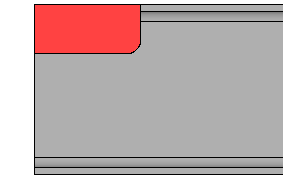
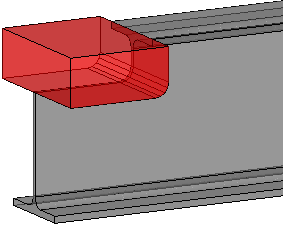
In this example the red plate defines the cut that is to cut the grey profile.
The red plate is drawn exactly on the top of the profile and exactly on the ending of the profile.
|
|
|
|
This is an example front and 3D view of the red cutout geometry exactly on the profile, which is not preferred |
|
Preferred example
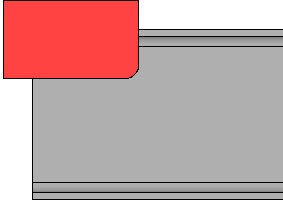
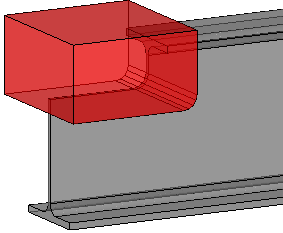
In this example the red plate defines the cut that is to cut the grey profile.
The red plate is drawn extending above the profile, extending farther than the ending of the profile, and then some geometry like the fillet inside the profile.
But the vertices, edges, and the faces of the plate are never drawn exactly on the faces of the profile. They will only intersect with the profile's vertices, edges and faces.
|
|
|
|
This is an example front and 3D view of the red cutout geometry drawn outside of the profile or inside the profile but never on top of the profile, which is preferred |
|
The reason why it is better to draw the parts this way is technical involving the subtraction that needs to be calculated on the profile.
If you really want to know :
The 3D modeler needs to calculate all the new vertices, edges, and faces of the profile that should result from the subtraction of the 2 3D models. When the subtracting part is drawn exactly on the profile then you are essentially asking for geometry of size '0' there.
This is impossible and this geometry of size 0 needs to be filtered out automatically during the subtraction.
If the geometry of size 0 is not removed then the 3D part becomes corrupt and nothing will be drawn.
This filtering out works in most geometrical cases but not always because of the complete freedom of modeling (each cutting scenario needs to be filtered out and programmed for individually).
Due to this it may seem that the un-preferred cutting works most of the time, but you may start to see failing cutouts on the more complex parts.